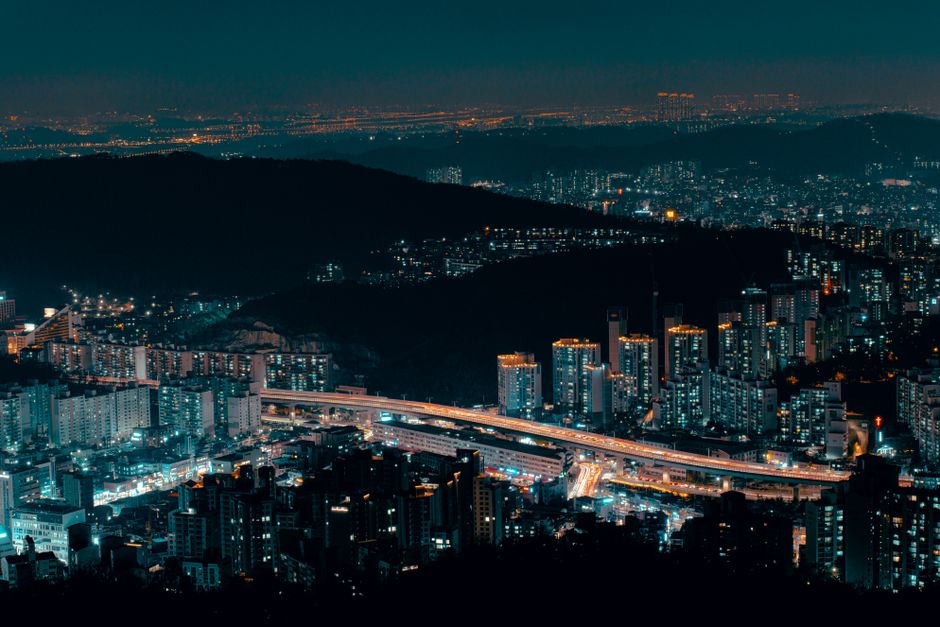
Seoul spent Thursday doing something it has not had to do often this year: defending a round number. The KOSPI opened soft, ran up to 7,072.79, then fell all the way to 6,898.45 in the middle of the session before institutional selling eased and the index clawed back to finish at 7,033.92, down 0.25%. Roughly 175 points separated the day's high from its low. The close was almost flat. The session was anything but.
The short version: The KOSPI held above 7,000 despite foreigners dumping a net 2.48 trillion won of stock on a quadruple-witching expiry, with Brent above $100 and long US yields grinding higher. Retail and institutional buyers absorbed the supply; the Kosdaq actually rose 0.79%.
| Market | Close | Change |
|---|---|---|
| KOSPI | 7,033.92 | −0.25% |
| Kosdaq | 836.92 | +0.79% |
| KRW/USD | 1,339.2 | won weaker by 3.1 |
| Samsung Electronics | 269,000 won | −0.19% |
| SK hynix | 1,853,000 won | −0.16% |
What moved the market
Three things pressed on Seoul at once, and none of them originated in Korea.
The first was oil. With no near-term prospect of Iran–US talks resuming, crude kept climbing: West Texas Intermediate pushed above $96 and Brent above $100 per barrel. For a country that imports essentially all of its energy and exports refined products and petrochemicals, a $100 handle on Brent is not an abstraction — it feeds straight into the trade balance, into input costs, and into the inflation numbers the Bank of Korea is currently watching very closely.
The second was the US bond market. The Treasury announced a $6 billion buyback of 10- to 20-year government bonds, which markets read as smaller than hoped. Yields went the wrong way. By the time Seoul opened, the two-year sat near 4.43%, the 10-year near 4.85%, and the 30-year near 5.30%. Long yields at those levels are a headwind for every high-multiple equity market, and Korea's index is now dominated by two very large, very expensive semiconductor names.
The third was expiry mechanics. Thursday was quadruple witching — stock index futures, index options, single-stock futures and single-stock options all rolling off at once. That is the most reliable source of one-day volatility in the Korean calendar, and it explains a good deal of why an index that finished down a quarter of a percent traded through a 2.5% range to get there.
The flows tell the story cleanly. Foreign investors sold a net 2.48 trillion won (about $1.85 billion) — a very large single-day number even by the standards of this year's foreign activity in Seoul. On the other side, retail investors bought a net 380 billion won and institutions a net 433.5 billion won. Domestic money took the paper. It has been doing so repeatedly through 2026, and Thursday was another test of that pattern that the domestic bid passed.
What is notable is what did not break. Overnight, US chip names had been firm after Meta unveiled its agentic AI system, Muse — the kind of headline that normally lifts Korean memory stocks on the open. It did not, quite: SK hynix eased 0.16% to 1,853,000 won and Samsung Electronics slipped 0.19% to 269,000 won. But neither cracked. In a session with this much external noise and this much foreign selling, two flat mega-caps are what kept the 7,000 line intact.
Sector by sector
Underneath the index, Thursday was a rotation day rather than a risk-off day.
Semiconductor equipment and materials were the standout. Jusung Engineering rose 7.02% and TSE gained 14.15% — the second and third derivatives of the memory cycle outperforming the memory makers themselves, which is often what happens when investors believe in the capex but think the large caps are fully priced.
Defense firmed on bargain hunting after recent weakness, with Hanwha Aerospace up 1.9% and LIG Defense & Aerospace up 1.49%. With Middle East tension driving the oil move, some of that bid is thematic as well as technical.
Insurance was the quiet winner of the rotation. Hanwha Life rose 4.73% and Samsung Life 1.98%. Higher-for-longer long-end yields are, unusually, good news for life insurers' investment income — the same force weighing on growth multiples helps this corner of the market.
Refining and chemicals went the other way, which is counterintuitive until you remember these names had already run on the crude move. S-Oil fell 6.21% and GS declined 3.44% as investors took profits into the strength.
The Kosdaq's 0.79% gain to 836.92 fits the same picture: the small- and mid-cap board, less exposed to foreign expiry flows and more exposed to the equipment and materials theme, had a straightforwardly good day while the large-cap index fought with derivatives.
The won and the macro picture
The won closed at 1,339.2 per dollar, weaker by 3.1 won. That is a modest move, but the direction matters: only a week ago the currency was at a 14-month high, and a stronger dollar plus $100 oil is the combination that historically pulls it back. Korea's terms of trade are being pushed in two directions at once — record semiconductor prices on the export side, expensive crude on the import side.
The export side is still winning by a wide margin. Cumulative 2026 exports passed $709.4 billion by September 5, already above the whole of 2025, and the Korea Customs Service has the country on course to become the fourth ever to ship $1 trillion in a calendar year, possibly by early December. Semiconductors did most of that: chip exports of $281.2 billion in January–August, up 169.6% year on year, now around 41% of everything Korea sells abroad.
That concentration is exactly what makes policy hard. The Bank of Korea has already raised its base rate twice this cycle — to 2.75% in July and to 3.00% in August, its first hikes since early 2023 — and said on Thursday that whether it goes again depends on how much of the chip windfall leaks into consumer prices. The mechanism the BOK is worried about is straightforward: rising chip export prices raise household and corporate purchasing power, and if that money gets spent, core inflation follows. Add $100 Brent to that and the inflation arithmetic gets harder, not easier.
What to watch next
Monday, September 14 is the structural event: the Korea Exchange launches its after-market session, running 4 p.m. to 8 p.m. KST with continuous real-time matching rather than the old 10-minute interval auctions. Limit orders only, market orders not accepted, and ETFs and ETNs excluded at the start. For overseas investors this is the most consequential change to Korean market microstructure in years — it puts several hours of Korean trading inside the European day. Whether foreign desks actually use it is the open question.
Beyond that: the first-10-days export figures from the customs service, which give the earliest read on whether September keeps the chip-driven run going; any further movement on Iran–US talks, since the oil bid is the swing factor for both the won and the inflation outlook; and the BOK's next rate decision, where Thursday's comments suggest the bar for another hike is the inflation pass-through, not growth.
For now, the index has done the thing that mattered. It held 7,000 on a witching day, into $100 oil, against 2.48 trillion won of foreign selling — and the domestic bid did the holding.
This is market information, not investment advice.