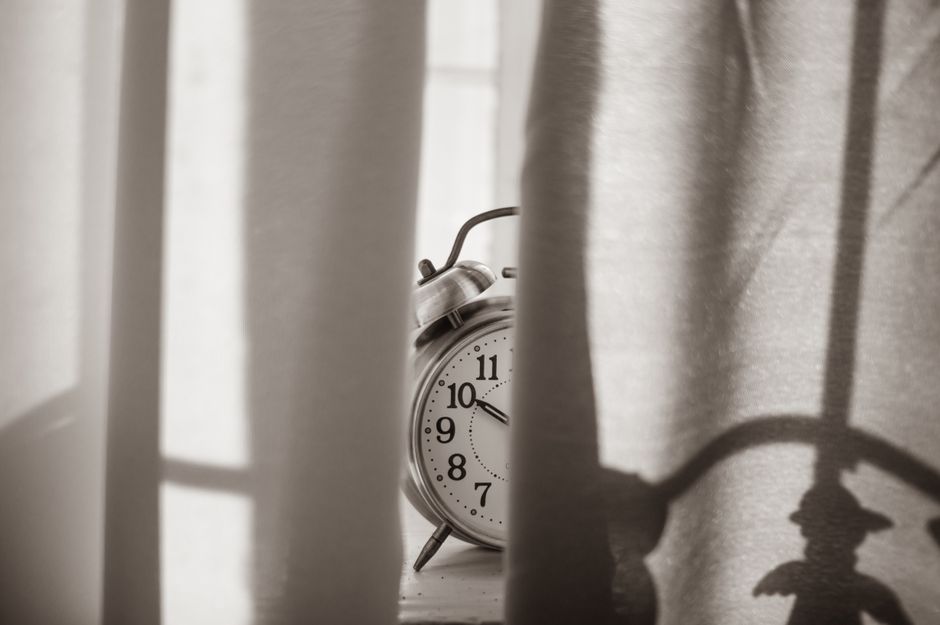
It is Sunday night, and you are wide awake. You slept until 11 a.m. both weekend days, felt wonderfully rested on Saturday, and now your body insists it is still mid-afternoon. Monday's alarm will land like a punch. If this loop feels familiar, you are not weak-willed. You have been quietly flying across time zones without leaving your bedroom.
Researchers call it social jet lag: the gap between the sleep schedule your body would choose and the one your work or school week forces on you. This guide explains what it is, why it matters, and how to shrink it without giving up your weekends.
What social jet lag actually is
Every person has an internal clock, or circadian rhythm, that runs on a cycle of roughly 24 hours. It nudges you toward sleepiness at certain times and alertness at others. Some of us are naturally early, some late, and most sit somewhere in between.
Social jet lag is the difference between your midpoint of sleep on workdays and on free days. If you sleep 11 p.m. to 6:30 a.m. during the week (midpoint 2:45 a.m.) and 1 a.m. to 10 a.m. on weekends (midpoint 5:30 a.m.), that is nearly three hours of drift. Your body experiences it much like flying from New York to Los Angeles every Friday and back every Monday.
You do not need a plane ticket to get jet lag. A Friday night out and a Saturday lie-in will do.
Why a "catch-up" weekend backfires
The instinct makes sense: you were short on sleep, so you pay the debt back. And extra sleep does help you feel better in the moment. The trouble is timing. Sleeping late pushes your internal clock later, because morning light, which normally anchors the clock, arrives hours after you would have seen it on a workday.
So Sunday night you are not tired at 11 p.m. You fall asleep at 1 a.m., wake at 6:30 on Monday, and start the week with a fresh deficit. Many people repeat this loop for years and conclude they are "just bad at Mondays."
A concrete example: someone who sleeps seven hours on weekdays and ten hours on weekends averages about eight hours across the week. On paper that looks healthy. In practice, the swing in schedule can leave them groggier than a person who sleeps a steady 7.5 hours every night.
What the research suggests
Studies reported by the American Academy of Sleep Medicine have linked larger social jet lag with worse mood, poorer self-rated health, and higher rates of heart disease risk markers. A broader body of work on sleep regularity (going to bed and waking at consistent times) points the same direction: steadier schedules tend to travel with better outcomes, sometimes more strongly than total sleep duration alone.
A few honest caveats belong here. Most of this evidence is observational, meaning it shows association rather than proof of cause. People with chaotic lives may have chaotic sleep for reasons that also affect health. Still, the pattern is consistent enough, and the fix is cheap enough, that it is worth acting on.
Consistency is not glamorous, but it may be the most underrated sleep habit there is.
A practical plan to shrink the gap
You do not need to become a monk. Aim to cut the gap, not eliminate it. Here is a gentle sequence that works for most people.
- Measure first. For one week, note when you fall asleep and wake up, work days and free days. Calculate the midpoints. Knowing your gap is half the battle.
- Cap the weekend lie-in. Try waking no more than 60 to 90 minutes later than usual. If you are exhausted, take a nap before 3 p.m. instead of sleeping in.
- Use morning light. Within an hour of waking, get outside or sit by a bright window for 10 to 20 minutes. Light is the strongest signal your clock responds to.
- Shift in small steps. Move your weekday wake time or bedtime by 15 minutes every few days, not two hours overnight.
- Protect the wind-down. Dim lights and put screens away 30 to 60 minutes before bed. Keep caffeine to the morning.
| Habit | Why it helps | Effort |
|---|---|---|
| Wake-time cap on weekends | Limits clock drift | Low |
| Morning daylight | Anchors the body clock | Low |
| Early afternoon nap (20 min) | Repays debt without delaying night sleep | Low |
| Consistent bedtime | Strengthens sleep regularity | Medium |
When the schedule is not yours to control
Shift workers, new parents, and students with early classes cannot always pick their hours. If that is you, focus on what you can control: a consistent anchor such as a fixed wake time on most days, light exposure at the start of your "day," and a dark, cool room for sleep whenever it happens.
If you struggle with persistent insomnia, loud snoring, pauses in breathing, or daytime sleepiness that interferes with driving or work, please talk to a doctor or sleep specialist. Those can signal conditions that habits alone will not fix, and this article is general information, not medical advice.
The short version
Social jet lag is the hidden cost of living on two schedules. Sleeping in feels like repayment but often delays your clock and makes Monday harder. The remedy is unglamorous: keep your wake time within about an hour or two across the week, get morning light, and nap early if you must.
Try it for two weeks. Your Mondays may thank you, and your Sundays might finally end at a reasonable hour. Sleep well.