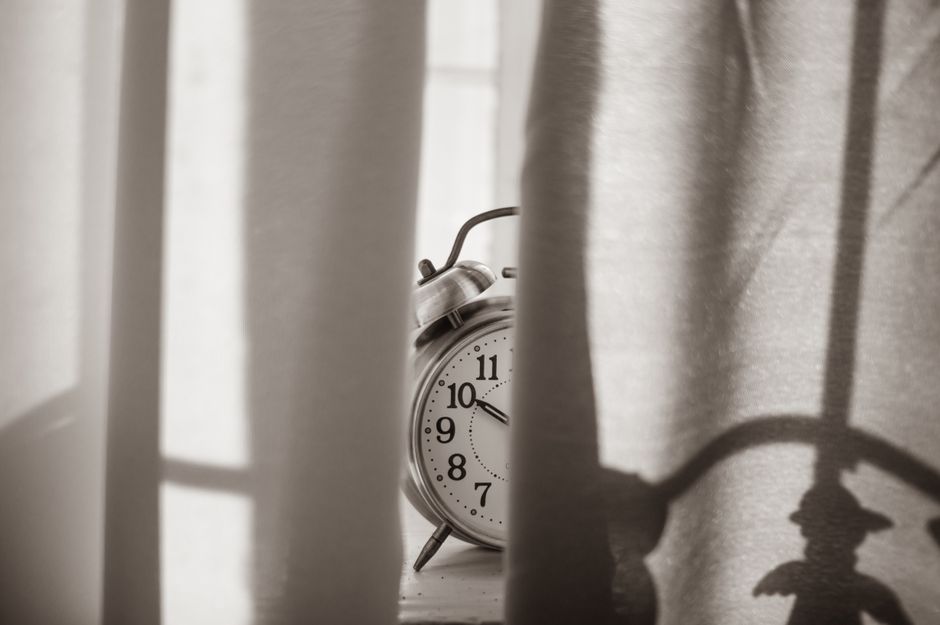
It is 3:40 on a Tuesday afternoon. The slides are due at five, your eyelids feel like they are lined with sand, and the office coffee machine is humming like an old friend. You pour a cup, finish the deck, and go home. At midnight you are staring at the ceiling, wondering why your brain won't switch off. You never connect the two events, because the coffee felt like a long time ago.
It wasn't. This guide explains how long caffeine stays in your body, how to find a caffeine cutoff time that fits your life, and how to keep your coffee habit without paying for it in bad sleep.
What caffeine actually does in your brain
All day long, your brain produces a molecule called adenosine. It builds up the longer you are awake and slowly raises your "sleep pressure," the feeling that you need to rest. Caffeine has a similar shape to adenosine, so it slips into the same receptors and blocks them. The sleepiness signal is still being sent; your brain just can't hear it.
That is why caffeine feels like energy but is closer to a mute button. When the caffeine wears off, the adenosine that piled up in the meantime is still there, which is the reason for the familiar afternoon crash.
Caffeine doesn't give you energy. It borrows alertness from later tonight.
This matters for sleep because the blocking effect doesn't stop when you stop feeling it. You can feel perfectly calm and still have enough caffeine on board to shorten and lighten your night.
The half-life problem: why 3 p.m. still counts at 9 p.m.
The key number is the half-life of caffeine: the time it takes your body to clear half of what you consumed. For a typical healthy adult it is around five hours, though individual values range from roughly 1.5 to 9.5 hours depending on genetics, liver enzymes, medications, pregnancy, and smoking.
Here is what a five-hour half-life looks like for a single 200 mg dose (about one large coffee):
| Time after drinking | Caffeine remaining (approx.) |
|---|---|
| 0 hours | 200 mg |
| 5 hours | 100 mg |
| 10 hours | 50 mg |
| 15 hours | 25 mg |
So a coffee at 3 p.m. leaves roughly 100 mg in your system at 8 p.m. and about 50 mg at 1 a.m. That is the equivalent of a small cup of tea or a can of cola sitting in your bloodstream as you try to fall asleep. If you had a second coffee at 4 p.m., the numbers stack.
A slow metabolizer, with a half-life nearer nine hours, would still have around 70 mg left at midnight from a single 3 p.m. cup. Two people can drink identical coffee at identical times and have very different nights.
What the research says about sleep
A well-known 2013 study from the Henry Ford Hospital sleep lab gave volunteers 400 mg of caffeine at different times before bed. Caffeine taken six hours before bedtime still cut total sleep time by more than an hour compared with a placebo. The striking part: participants often didn't notice. Their own sense of how badly they had slept lagged behind what the sleep monitors recorded.
Other research points the same way. Caffeine late in the day tends to delay your internal body clock, make it take longer to fall asleep, and reduce deep sleep, the stage most associated with feeling physically restored. Less deep sleep rarely feels dramatic. It feels like waking up a little foggy, then reaching for more coffee, which restarts the loop.
The most reliable sign that caffeine is hurting your sleep is needing caffeine to recover from it.
None of this means coffee is bad. Moderate intake is considered safe for most healthy adults; health agencies such as the FDA cite about 400 mg per day (roughly four small cups of brewed coffee) as an amount not generally associated with harm. The issue is mostly timing, not quantity.
How to find your personal caffeine cutoff
A common rule of thumb is to stop caffeine at least 8 hours before bedtime, which accounts for the six-hour finding with a little margin. For someone going to bed at 11 p.m., that means the last cup around 3 p.m. Treat this as a starting point, then adjust:
- You fall asleep slowly or wake at 3 a.m.: try 10 hours before bed for two weeks.
- You sleep like a rock regardless: you may be a fast metabolizer, but check by testing one week without afternoon coffee before assuming.
- You are pregnant, on oral contraceptives, or taking certain medications: caffeine can linger much longer. Ask your doctor or pharmacist.
- You are a shift worker: count backward from your bedtime, not the clock on the wall.
The experiment is simple. For 14 days, move your last caffeine earlier by two hours and note how long it takes to fall asleep and how you feel at 10 a.m. Many people discover that the morning grogginess they blamed on "not being a morning person" was an afternoon latte talking.
Hidden caffeine and smarter swaps
Coffee isn't the only source. Tea, energy drinks, cola, pre-workout powders, dark chocolate, and even some pain relievers contain caffeine. A 3 p.m. square of dark chocolate is minor, but an energy drink can carry 150 to 300 mg.
If you love the afternoon ritual more than the buzz, change the content, not the habit:
- Decaf coffee still has a small amount (about 2 to 15 mg) but tastes like the real thing.
- Herbal tea or rooibos gives you the warm mug without any caffeine.
- A 10-minute walk in daylight raises alertness through light exposure and movement, and it also helps set your body clock.
- A glass of water and a snack. Mid-afternoon slumps are often dehydration or low blood sugar rather than sleep debt.
If you must have caffeine late, consider a smaller dose. 50 mg at 4 p.m. is a very different proposition from 200 mg.
Don't forget the morning
One more trick: delay your first coffee by 60 to 90 minutes after waking. Your body naturally releases cortisol early in the day, and some people find that caffeine taken at that moment gives less of a lift and sets up a stronger crash. The evidence here is thinner than for evening cutoffs, so see it as an experiment rather than a rule. The upside is that a later first cup naturally pushes the whole schedule in a healthier direction.
The takeaway
Caffeine has a half-life of about five hours, so the coffee you drink in the afternoon is still working while you try to sleep. Aim to finish your last caffeinated drink about eight hours before bed, adjust based on two weeks of honest notes, and swap in a decaf or a walk for the afternoon dip. If sleep problems persist for weeks, talk with a healthcare professional, since poor sleep has many causes and caffeine is only one of them. Information as of writing; this is general education, not medical advice.
Tomorrow afternoon, try it once: pour the decaf, take the walk, and see what midnight looks like. You might meet a version of yourself who falls asleep before the second chapter.